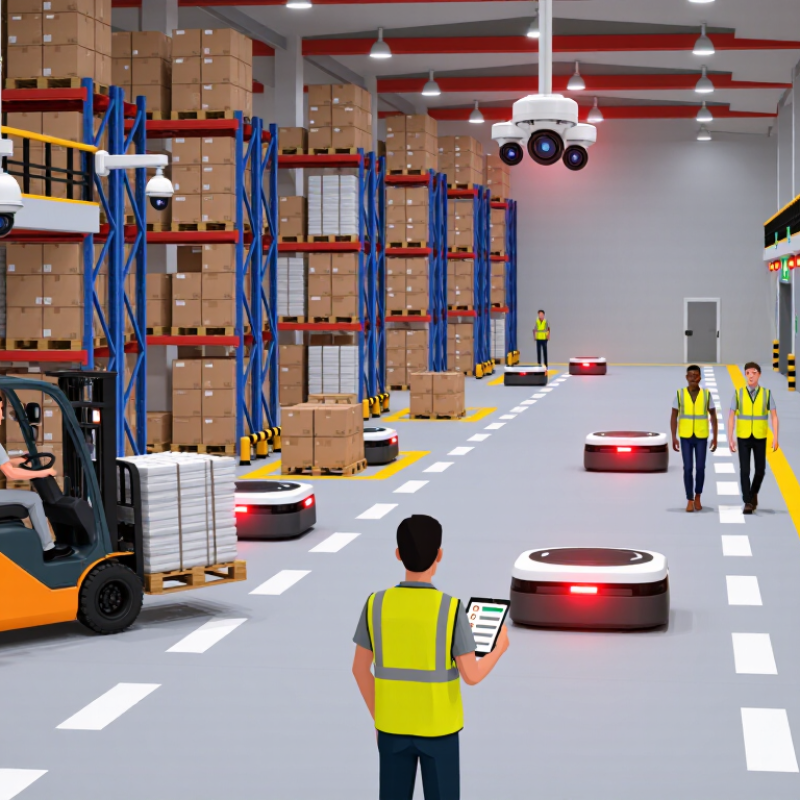
Warehouse Safety in 2026 will depend on more than signs, training videos, and occasional inspections. It will require practical systems that protect people during real warehouse pressure. Forklifts may pass within meters of pedestrians, while scanners, robots, and stacked pallets compete for limited space. A safe facility makes these risks visible before someone gets hurt.
This guide explores how warehouse leaders can strengthen daily controls, improve worker involvement, and use technology responsibly. It considers traffic separation, storage stability, equipment checks, emergency readiness, fatigue, and clear reporting procedures. Wearable sensors and automated alerts may identify dangerous patterns, but they cannot replace experienced supervision. A manager still needs to walk the floor, listen carefully, and notice the loose shrink wrap near a loading bay.
Strong programs also reflect recognized industry practices, documented risk assessments, and reliable training records. Local requirements should be checked with qualified safety professionals. Procedures must match the actual site, not an attractive template copied from another operation. That weakness is common. A policy can look complete while workers quietly bypass it because the process slows urgent orders.
Improvement should therefore be measurable and honest. Track near misses, blocked exits, damaged racks, and repeated unsafe shortcuts. Review those findings with employees who perform the work. Their experience often reveals hazards that dashboards miss. Small corrections matter. A clearer pedestrian route, brighter floor markings, or a two-minute equipment check can prevent serious consequences. Yet no plan stays perfect. Warehouse Safety must be reviewed regularly, tested during busy shifts, and adjusted when people, layouts, or technology change.
How to Improve Warehouse Safety in 2026?
OSHA estimates that forklifts contribute to about 85 workplace deaths and 34,900 serious injuries each year. These figures make forklift risk impossible to treat as routine. In 2026, warehouse managers should assess traffic routes, loading zones, blind corners, and pedestrian crossings every week. A clean floor helps, but it cannot replace disciplined vehicle control.
Walk through the facility during a busy shift. Observe speeding, blocked sightlines, unstable pallets, and workers stepping into turning paths. Test horns, lights, brakes, seat belts, and warning alarms before each shift. Keep inspection records specific. “Checked equipment” is too vague to support reliable follow-up. Training should include practical driving, load handling, ramp use, and emergency response.
Small failures can become fatal.
Many warehouses depend too heavily on written procedures. That is a weakness worth admitting. A perfect policy cannot stop unsafe behavior when production pressure rises. Supervisors should pause operations after near misses and ask what encouraged the shortcut. Separate forklift lanes where possible, install visible barriers, and improve lighting near racks. Review operator authorization regularly, especially after transfers or long absences. Workers must also have a clear way to report damaged equipment without fearing punishment. Safety improves when observations become corrective actions, not forgotten paperwork.
Annual forklift-related deaths and injuries reported by OSHA
OSHA estimates that forklifts are associated with approximately 85 worker deaths and 34,900 serious injuries each year in the United States. These figures highlight the need for 2026 warehouse safety programs to prioritize operator training, pedestrian separation, speed control, visibility, equipment inspections, and clearly marked travel routes.
Source: U.S. Occupational Safety and Health Administration (OSHA), forklift safety statistics.
Powered industrial trucks remain a serious warehouse risk. OSHA estimates that forklifts cause about 85 workplace deaths and 35,000 serious injuries each year in the United States. Under OSHA 1910.178(l), every operator needs formal instruction, practical training, and workplace evaluation. Training must cover truck controls, load stability, pedestrian traffic, ramps, and site-specific hazards. It cannot end with a classroom signature.
Experienced supervisors should watch each operator move a real load. They should check turning speed, visibility, horn use, and parking discipline. Employers must evaluate operators before assignment and at least once every three years. Refresher training is also required after unsafe operation, an accident, a near miss, or a change in workplace conditions. A certificate alone proves little. I have seen competent workers rush during peak shifts. That human factor deserves more attention.
Tips: Mark walking lanes with durable floor lines. Use mirrors at blind corners. Keep loads below the rated capacity. Require seat-belt use where provided. Record training dates, evaluator names, and observed skills. Review near misses monthly. OSHA’s safety guidance and NIOSH research both emphasize separating pedestrians from moving equipment. Still, many facilities rely on memory instead of measurements. Track speeding events, blocked aisles, and repeated retraining needs. The numbers may expose uncomfortable habits before an injury does.
Warehouse safety in 2026 should start with NIOSH’s Hierarchy of Controls, not another warning poster. The method ranks elimination and substitution above engineering, administrative controls, and personal protective equipment. That order matters. A 2024 U.S. Workplace Safety Index estimated serious workplace injuries cost billions in medical expenses and lost productivity. Warehouses cannot manage that cost through training alone.
For racks, remove damaged uprights from service immediately and redesign aisles to separate pedestrians from powered equipment. Install guardrails, rack-end protection, and load-rated signage. NIOSH recommends regular inspections because small impacts can weaken structural members. The wrong assumption is that an empty-looking rack is safe. Keep inspection photos and repair dates. They expose repeated damage patterns.
Conveyors need fixed guards at nip points, accessible emergency stops, and controlled access during clearing. Robots require mapped exclusion zones, speed limits, and verified lockout procedures. A 2023 workplace injury analysis identified overexertion and contact with objects among major cost drivers, making automation helpful but not automatically safe. Sensors can fail. Workers can improvise. Test those weak points during real shifts, not only scheduled audits. Track near misses, blocked exits, struck-rack events, and restart delays. Review the data weekly with operators. Five-minute conversations often reveal hazards that formal inspections miss.
Monthly safety audits should treat BLS recordable-injury and DART rates as operating signals, not paperwork. The U.S. Bureau of Labor Statistics reported a 2023 private-industry recordable rate of 2.4 cases per 100 full-time workers. Its transportation-and-warehousing category recorded a higher rate, about 4.4, with DART near 2.7. These figures come from Employer-Reported Workplace Injuries and Illnesses, 2023. They offer a practical external benchmark. Do not compare a small site directly with BLS data without checking its industry scope.
Use consistent formulas each month. Multiply cases by 200,000, then divide by total hours worked. DART includes days away, restricted work, and job transfers. Reconcile incident logs, first-aid records, payroll hours, and restricted-duty notes. Then walk the dock. Look for blocked pedestrian lanes, damaged pallets, blind forklift corners, poor lighting, and rushed loading. Plot every case by shift, task, body part, and hazard. One total rarely explains the cause.
A rolling 12-month rate reduces distortion from seasonal hiring or one severe event. OSHA’s recommended practices also support worker participation, hazard correction, and management review. Do not celebrate a zero month too quickly. A quiet report may reflect underreporting, delayed diagnosis, or weak supervisor training. That uncomfortable gap deserves an audit action, not a polished dashboard.
Warehouse safety in 2026 will depend on daily habits, not occasional reminders. A strong safety culture starts when workers can report hazards without fear of blame. Reporting should cover blocked exits, damaged pallets, poor lighting, near misses, and unsafe lifting. Keep the process simple. A worker should report a loose floor mat in less than one minute.
Supervisors need to respond visibly. They can review reports during shift meetings, assign corrective actions, and explain what changed. Each report should include the location, time, hazard, immediate control, and follow-up owner. Patterns often matter more than isolated events. Repeated forklift congestion near a loading door may reveal a layout problem. A practical lesson is that our first reporting form asked for too much detail. Workers stopped using it. We had to shorten it.
Training should match real tasks. New employees need guided practice with pedestrian routes, equipment checks, manual handling, and emergency communication. Experienced workers also need refreshers when processes change. Short sessions work well when they use actual photos, damaged packaging, and realistic decisions. Trainers should ask workers to demonstrate the safe action, not only repeat instructions.
Drills make procedures usable under pressure. Practice spill response, evacuation, first aid communication, and equipment failures. Measure response time and observe confusion points. Do not stage dangerous conditions. Keep drills controlled and accessible. Some employees may hesitate to speak during reviews. Private feedback can reveal more. Not every drill will run smoothly. That is useful evidence, not failure.
Review traffic routes, loading zones, blind corners, and crossings every week. Walk the facility during its busiest shift. Look for speeding, blocked views, unstable pallets, and turning-path conflicts. Small failures can become fatal.
Test horns, lights, brakes, seat belts, and warning alarms. Record specific findings, not vague notes like “equipment checked.” Remove unsafe vehicles from service until repairs are confirmed. Details matter.
Training should cover driving, load handling, ramps, pedestrian awareness, and emergency response. Operators need practical exercises, not only classroom instructions. Authorization should be reviewed after transfers or long absences. Procedures alone may fail under production pressure.
Separate pedestrian lanes from vehicle routes where possible. Add visible barriers near crossings and turning areas. Improve lighting beside racks and loading docks. Ask workers where shortcuts happen.
Remove damaged uprights from service immediately. Use guardrails, rack-end protection, and clear load-rating signs. Photograph damage and record repair dates. An empty-looking rack is not automatically safe.
Install fixed guards around conveyor nip points. Keep emergency stops accessible and test them during real shifts. Map robot exclusion zones and set suitable speed limits. Sensors can fail.
Track recordable injuries and DART rates each month. DART includes days away, restricted work, and job transfers. Use one consistent formula: cases multiplied by 200,000, divided by hours worked. Reconcile logs with payroll and restricted-duty records.
Near misses can reveal blocked exits, struck racks, rushed loading, or poor lighting. Review incidents by shift, task, body part, and hazard. A zero month may reflect underreporting or delayed diagnosis. That gap needs investigation.
Improving Warehouse Safety in 2026 requires a proactive, data-driven approach. Begin by assessing major risks, including forklift incidents, struck-by hazards, falls, rack failures, conveyor injuries, and human-robot interactions. Recent safety figures reporting 85 forklift-related deaths and approximately 34,900 injuries demonstrate why every powered-truck operator must complete documented training, practical evaluation, and periodic refresher certification under the applicable industrial-truck safety standard.
Facilities should apply the hierarchy of controls by eliminating hazards where possible, using engineering protections such as rack barriers, machine guarding, separation zones, and emergency stops, and supporting these measures with clear procedures and personal protective equipment. Monthly audits should track recordable injuries, restricted-duty cases, lost-time events, and DART-style rates to identify trends early. A strong 2026 safety culture also depends on encouraging near-miss reporting without retaliation, providing role-specific training, inspecting equipment routinely, and conducting realistic emergency drills. Consistent leadership participation and continuous improvement can turn Warehouse Safety from a compliance task into a daily operational priority.

Fangding Rack